 At about 7:30 am, they start hauling in the fishnet that the men had cast out at sea hours ago. Very far away, another line of men and women are pulling in the other end of the net.
 The old and the young put in the much needed strength to pull the net. This is their early morning aerobics exercise. More sophisticated folks could have done the same in the gym with better results. But for these simple folks, they do their exercise as they seek for food for their tables.
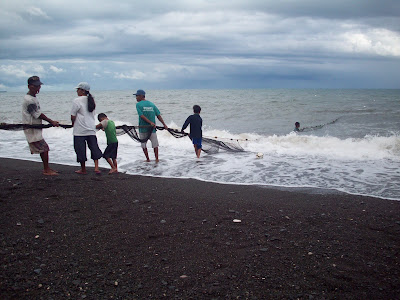 As the end of the line looks near, the folks hope that it could be a good catch. They hope that today must be better than yesterday.
 The two lines of people get nearer...
 ... and nearer. So is the awaited catch.
 Small boys run to see what is enstored for them. Will they have a good meal today? Will their parents now buy them their requirements for school?
 Ah, there it is! That net could make our day....
 The boys seem to think that it is a heavy load. But nobody is cheering......
 And the prized catch! Still nobody is cheering....
 Behold! The fruit of hours of hard labor! And it doesn't even fill the shallow container. Yesterday, the catch was better. Yesterday's catch filled up seven containers.
 Transient and local buyers start to flock to buy some of the catch. But the folks cannot sell. No, not yet. They first have to divide the measly catch among the so many stakeholders. And before they can even divide the catch mong themselves, they first have to wait for the person with whom they pawned the net they used. By practice, the de facto owner of the fishnet will first get his share before anyone lays a hand on the catch.
 Meantime, while the olds wait for the owner of the net and the young ones play to while away the emptiness in their tummies, the men check on the net...
 .. before they roll it for safekeeping, and ready to be unrolled again the following day for, hopefully, a better catch.
 Others continue on their aerobics exercise by pushing the boat to higher grounds.
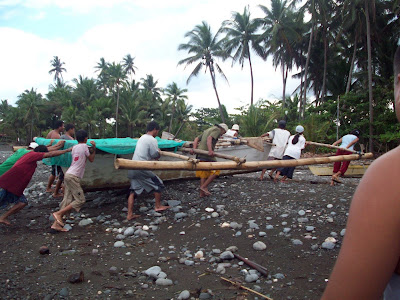 The weather can turn bad and the seas can be nasty. But the boat will now be safe. Today the catch is disappointing. But tomorrow is another day. And with the net and the boat safe and in good condition, and with the fisherfolks working as a team and undaunted by the challenges in life, tomorrow may just yield a better catch. @
Wednesday, September 16, 2009
Culasi, Antique: A day in the life of the fisherfolks


Wednesday, September 2, 2009
Fish spa in Tibiao
 Want to experience something unusual? Why not drive to the municipality of Tibiao in Antique and savor the experience of a fish spa – when locally endemic fishes peck and nibble your feet triggering an orgasmic sensation that will make you forget your woes including your name?


The Tibiao Fish Spa was put up by three enterprising University of the Philippines graduates, one of them Flord Calawag, 8th placer in the October 2008 Fisheries Technologist Licensure Examination. (To note, the 7th placer in the same board exams was Joshua Militar Regalado, the son of Bambi M, an elementary classmate and two-time Miss Cabatuan.)
Being Fisheries graduates, the triumvirate conceived of a project using, what else but their most favorite creatures – fishes. They worked out a technology, which they have submitted for patenting, to convert any wild fishes that scamper to safety at the site of homo sapiens, into amiable pets which looked forward to caressing, tickling, and pampering whatever part of the human body that is submerged in the water.


As soon as we arrived, the quite neighborhood was turned into a giggling, screaming riot as tiny fishes tickled the soles of everybody.
The spa is in the residence of the Calawags beside the main highway. It is composed of two sections. Inside the house is a sitting area covered with loose black shiny pebbles where patrons can sit on woven palm-leaf mats beside an L-shaped wading pool filled with small fishes which the owners called 'small Therafish'. (The original Doctor Fish used in fish spas abroad is Garra Rufa, a native of Middle Eastern countries.)
The other section is outside the house. It is a covered long pool about 2-feet wide with bamboo benches on the side. The pool is filled with fishes which are comparatively larger, with larger mouths and bigger teeth, which could be just right for those with soles as hard and as thick as the soles of rubber shoes and/or for those whose leg skin is as rough as the surface of sandpaper. White small towels are available to the patrons. But first aid kit and in-house doctors are not available as the owners are confident the fishes will just nibble on dead skin and not gorge on whole human legs.


The size of some fish is big enough to become a fitting viand after the spa session.
My personal experience in the Tibiao Fish Spa was comforting and could be a lesson to those wanting to avoid embarrassment in the place. When I dipped my feet in the cold waters, all the fishes swam to my direction and fought for choice positions over my skin. I imagined that I could have the dirtiest and smelliest pair of feet in the whole of Tibiao that minute. I was delighted by the sight of schools – no, universities - of fishes fighting for the dermal morsels, and the ticklish sensation when the fishes came in contact with my skin. But my nieces cried in protest as only the skinny and lazy fishes serviced them while all the agile ones attacked my feet like swarms of flies and vultures to a decaying carcass. As a caveat, when you don’t know the other patrons, wash your feet well in the washing area before you dip them in the pool. Else, when your feet become a magnet to all the hungry fishes, you’ll be incensed when informed by a stranger nearby, that fishes are attracted by smelly objects like ginamos or earthworms wriggling in spit. Or you’ll be thrown out by the management and banned for life for knowingly feeding the fishes with unknown, and possibly deadly objects, residing on your feet. On my part, I was greatly relieved that none of the fishes floated belly side up, when I dipped my feet in the pool for 10 minutes.


The Tibiao River, site of an international whitewater kayaking competition (top left). Centuries old balete tree crowning the site of a cave (top right). Spelunking (below left). Hanging bridge (below right). During the typhoon Frank flood, the waters rose until chest high of those crossing the bridge.


Jungle fever and wild flowers galore.
The ambiance in the fish spa is homey and not commercial. There is no restaurant but the caretakers will cook whatever supply you bring at no extra cost. Excursions and activities to nearby areas can be arranged through the Tibiao Tourism Office or the Department of Tourism Regional Office in Iloilo City. Some activities that can be arranged are mountain climbing to Bugtong Bato waterfalls and whitewater kayaking in the Tibiao River. Tibiao hosted the International Whitewater Kayaking Competition in 1999. Flord volunteered to tour us around but because of the bad weather our tour was limited to viewing over a hanging bridge the rampaging currents of the Tibiao River. He brought us to a cave which was used as a hiding place during World War II and to their family farm which he envisioned to become a fish spa complex where people can play tong-its under the grafted mango trees as indigenous puyo or turagsoy massage their feet.
So, for those who have time to spare, try the Tibiao Fish Spa. You don’t just experience the unusual but you also boost the local economy and help our new graduates discover their entrepreneurial capabilities. Astig.


Sights: Mode of transportation, land mine, and the place we stayed overnight in Culasi.

In our family outings, only the terminally old is exempted. We bring ample food supply so we can eat anywhere we please. This time, breakfast beside the highway in Hamtik.
Please click pictures to enlarge. @
Sunday, May 25, 2008
Our trip to Pandan, Antique
Tired of Boracay? Go to Pandan and Sebaste in Antique, and savor nature at its best.
Pandan is a northerly town of Antique province. It is about 4 hours drive from Iloilo City and 30 minutes drive from Caticlan, the jump-off point to the island of Boracay. The roads are safe, and the scenery is bucolic.
Tourism in the town is not on the level of Boracay. Not even a fraction. Pandan is a languid coastal town still untouched by developers. And that’s the catch. You can have the town to yourself for the rest of your visit.


Try to arrange for a local guide to accompany you in the town. I recommend Rex Zaldivar (cellphone# will be given those interested), nephew of the incumbent Antique governor, and a native of the place. He can arrange for all the excursions, resort accommodations, courtesy calls to retired national government bigwigs who reside in Pandan (all are his relatives; his surname is only Zaldivar.); tell you the folklores, and accompany you to the market for fresh food.
Must-visit is the Malumpati Spring Resort. The resort is a dammed portion of a river. The water is cold, clean, and medicinal as many believed. There are shallow portions suitable for kids and deep portions for diving. What was unique in the waters was the presence of fishes not found in other places. Malumpati also provides unchlorinated natural drinking water to the whole of Pandan.


The Malumpati Spring Resort
The resort asks for a nominal entrance fee, for the upkeep. Sheds and sitting areas are available. The restrooms are clean. The resort has some air-conditioned bungalows for rent if you decide to stay for the night, or for the long term.
A 30-minutes walk upstream to the source of the river is also allowed to few visitors. According to Rex, access to the source is strictly curtailed in order not to upset the ecosystem and also not to pollute the waters. As we entered the restricted area, we noticed that the only hint of visitors was the barely perceptible footpath. There were no plastic cans nor wrappers, no carabao droppings, no other noise but our own and those of the birds, the insects, and the splashing river. The water is so clean you can drink from beneath your feet.


The Malumpati head water.
Picture this - lush, craggy mountainsides; orchids and vines embracing tall trees; fern-covered boulders seemingly lost in mist; smoky glens dappled with wild flowers; the absence of city sounds. This picture makes this place ethereal, enchanting. After we crossed a bamboo hanging bridge, Rex asked us to observe silence as we neared the head water. The silence made audible muted sounds like some unseen people whispering the rosary. But, aside from the fishes, we were the only visible animalia in this eerie expanse. Could it be that this place was restricted because this really is a place of enkantos? The river source is a blue, silent waterhole, barely the size of a basketball court, at the foot of the mountain. Yes silent water is really deep. We were informed that the source is an underground river from another town. We could not imagine that this quiet hole is transformed into a noisy raging current about 50 meters away.
Malumpati has fresh waters, a welcome change from the salty waters of the sea. But if you are not tired of the beach, Pandan has kilometers of sandy uncrowded beaches to offer. You can light bonfires at night. Rex can book you in a beach resort, whatever is your budget.
A pumpboat cruise through Bugang River, recipient of the “Gawad Pangulo sa Kapaligiran” award as the cleanest river in the Philippines, can also be arranged. Gush as village women and children give you a send off with calachuchi flowers (frangiapani).


Bugang River is indeed redundantly clean. There are no floating plastics and other human trash. Its banks of mangroves, nipa, exotic flowers and centennial trees are undisturbed. Dangle your feet unto the water, and let the current soothe your soles as the boatmen assure you that no crocodile can possibly live in such a sterile environment. Greet the few locals swimming and washing clothes ashore. Marvel at the absence of houses straddling the banks. Get down the pump boat at the far reaches upstream, and wade where the pebbles are all hues of yellow, orange, cream, and green. Eat budol-style where everybody stands around a small bamboo table where rice, and grilled fish and pork are all heaped over banana leaves; each one takes and eats from the heap with bare hands. No plates and spoons to wash. Saves on soap and water. Neat. After lunch, wonder at the likelihood of crocodiles courting humans. Because at the far bank is a lifesize tableau with two crocodile statues fighting over a maiden. With prior notice, a local elder can come and recite in Kiniray-a the legend that gave rise to the tableau.


(2nd L – R) Flower or fruit? What looks like a man-made floral arrangement is actually a bunch of flowers, or fruits, on a single stem. The inner globe is made up of tiny clusters of black berries, while the yellow globules are protruding clusters of yellow berry-like flowers. Locals call it lapad. (2nd R – L) Eating budol-style)
Next town to Pandan is Sebaste, another coastal town with a lot to offer inland. Its best attraction is Igpasungaw Falls.
We headed to the falls with two guides, courtesy of the Office of the Sebaste Municipal Mayor. In this seemingly uncharted destination, a local guide is a must. We picked up the guides, bought some fresh fish from the local market, and drove for about three kilometers off the national highway. We left our cars where the dirt road turned into a footpath.
The way to the falls was curved along the sides of the river, which was good and bad at the same time. It was good because the river and the scenery were breathtaking; and the sounds of the plunging waters lulled us to believe that the falls was just around the bend, although the 30-minutes walk said otherwise. It was bad because river mists made the rocks constantly wet. But we learned our lessons, such as: 1) Don’t step on wet rocks. They are bound to be slippery. 2) If all rocks are wet, don’t step on those covered with moss. They are more slippery. 3) If you see your children balancing precariously on obviously slippery boulders, where a misstep means a 5-meter drop to the next watery ledge, don’t shout. Instead, be stoic. Hyperventilate. And pray. You don’t have to go this far to have a heart attack. 4) Of course, the place needs to be visited during the summer months when there are no rains. But, what the heck! It rains even during summer!


If Malumpati is an enchanted eden, the way to Igpasungaw is a jurrassic jungle, we can easily bump into Tarzan. Boulders, not pebbles, rule the riverbed. The trail is, at many instances, only a foot wide with the rampaging river down one side, and the twisting roots of trees up the other side. The vegetation appears lavish you will feel guilty to tear a leaf as the plant may cost thousands in the mall. The air is littered with confettis of iridescent butterflies. For us who were new to mountain climbing, and with kids in tow, this was a good practice. No rappelling required. And the bends and the thick vegetation somehow screen from view the vertiginous heights and the dangerous miscues.
This is Igpasungaw Falls.
Halfway atop the mountain was the Igpasungaw Falls. It was a refreshing sight. It was worth the hard climb. Only a few of us adults reached the main falls. We left the kids swimming in a waterhole about 50 meters downstream because the way up was very slippery. We were told that, if we continue climbing to the source, we would encounter more minor falls.


Back in the poblacion of Sebaste, our guides brought us to the parish church and introduced us to the original statue of St. Blas, their patron saint. The guides informed us that, a long time ago, the statue was brought to Pandan town for safekeeping. Then, the statue disappeared and was later found back in Sebaste, in the exact place where it used to stand. The statue’s shoes were covered with mud, its long robes prickled with weeds, as if it walked from afar. Since then, the statue was deemed miraculous and is visited by thousands of devotees.
We, adults, were dead tired as we drove back to Iloilo City. But the kids were unperturbed. They talked about their experiences and the sceneries. They loved the places we visited. But they thought they might not return back because the places were not yet developed. In my mind, I just thought that they were lucky. They were lucky because they saw and experienced Pandan and Sebaste before the towns are turned into another commercial and ravaged Boracay. @
Ga-patad ka sa LOTTO? I-memorize ang numero nga ini....


